
Housing New York’s incoming workforce, Micron workers and more
Jeff Cook of Cook Properties lays out the factory-made options available in central and western parts of the state.
By Ralph R. Ortega

Jeff Cook is on a campaign to educate local and state government officials about the advantages of factory-made housing and how it is ready to accommodate the need for affordable housing. It’s also an option for the wave of 50,000 workers coming to Central New York to build and work for chipmaker Micron.
Cook serves as managing partner and CEO of Cook Properties, a role he’s held for about 25 years, expanding the company from a single manufactured-home park to more than 100 communities with more than 7,000 lots across New York state.
OD&A’s “On the Record” caught up with Cook to discuss how he’s getting his messaging out on factory-made housing, the incoming workforce that will need that housing, and how he’s overcoming the stigma overshadowing a growing industry.
This interview was edited for length and clarity.
Thank you, Jeff, for joining us today. As New York State continues to attract major manufacturing investments and expand its industrial base across upstate, those investments are going to bring in new jobs, new residents and increased demand for housing. How can transforming vacant lots in cities like Buffalo, Rochester, Syracuse, Albany, and Binghamton into new homes help meet that growing demand while strengthening neighborhoods, expanding the tax base, and supporting the region's broader economic growth?
For one, it's kind of low-lying fruit. It's available. One of the things that is a challenge to economic development, particularly in New York state, is the lack of available, ready-made sites, especially for residential housing. Most housing developed is greenfield development. You need everything — it's just dirt. You need all your utilities, you need roads, which is all extremely expensive, not only supplies but labor. The city of Rochester, for example, has, I think, 4 or 5,000 vacant lots. The city of Buffalo has, I think, 6 or 7,000 vacant lots, and those are much more ready to go than a greenfield site. The utilities, the main utilities are right there. It's really just the site work on the lot itself, and then, of course, possibly running new lateral utilities off of the mains. So much of the work is already done. It just makes a lot of sense to go that route for some single-family housing.
Is it a matter of will before these lots are actually developed?
I think so. I think a lot of it is just proof of concept. There's not a lot of history with using manufactured housing in the cities, in an urban area. I think it fits really well. Our homes can be anywhere from 14 feet wide, all the way up to 30, 32 feet wide, which fits really nicely on most of your city lots. So part of it is just let's go slow to see how it works and how the public and the customers view manufactured housing, because it hasn't been used in that format yet. ... I think it's just more a little bit of caution.
Coming around to it, I see — like educating.
For sure.
Your homes are factory-built and priced below a conventional new house. Could you give me the numbers on how much faster from lot to move in and how much less does a buyer actually pay?
Generally, your least expensive home, I would say $200,000 is a good number, low 200s. It really depends on finishes, but that's a good solid estimate. And that would be for when a homeowner owns the land and the home together on a fee-simple basis. What was the second part of your question there?
How much faster from lot to move in?
So if we have a lot that's ready to go, with no site work or the site work's already completed, we could have a double-section home, which is most of what we would do in the city, ready to go in a month, and that typically what we're waiting on is (Rochester Gas & Electric) to hook up the power. But site work, you're probably another 22 weeks or so if everything goes well. So on the quick side, 30 to 60 days. That doesn't include the manufacturing process. Right now they're running about a 6 to 8 weeks backlog.
It's such a shorter time when you've got the lot all ready to go. Tell me who builds these homes and where. Are those factory and installation jobs local? What kind of training does someone need to get one?
They are local. There's the three — we call them the three big Cs: Cavco, Champion and Clayton. Those are the three largest manufacturers of manufactured homes in the country. They have about 80% of the market. Locally, we source our homes from a Cavco factory in Pennsylvania. Another factory in Pennsylvania is the Clayton factory, and then the one New York state factory is a Champion factory, south of Utica. We just had a factory tour yesterday and they had about 120 employees there. But they are local jobs. The Champion factory that we visited is non-union, but they all are local, good, well-paying jobs in a very safe environment, in a climate-controlled facility.
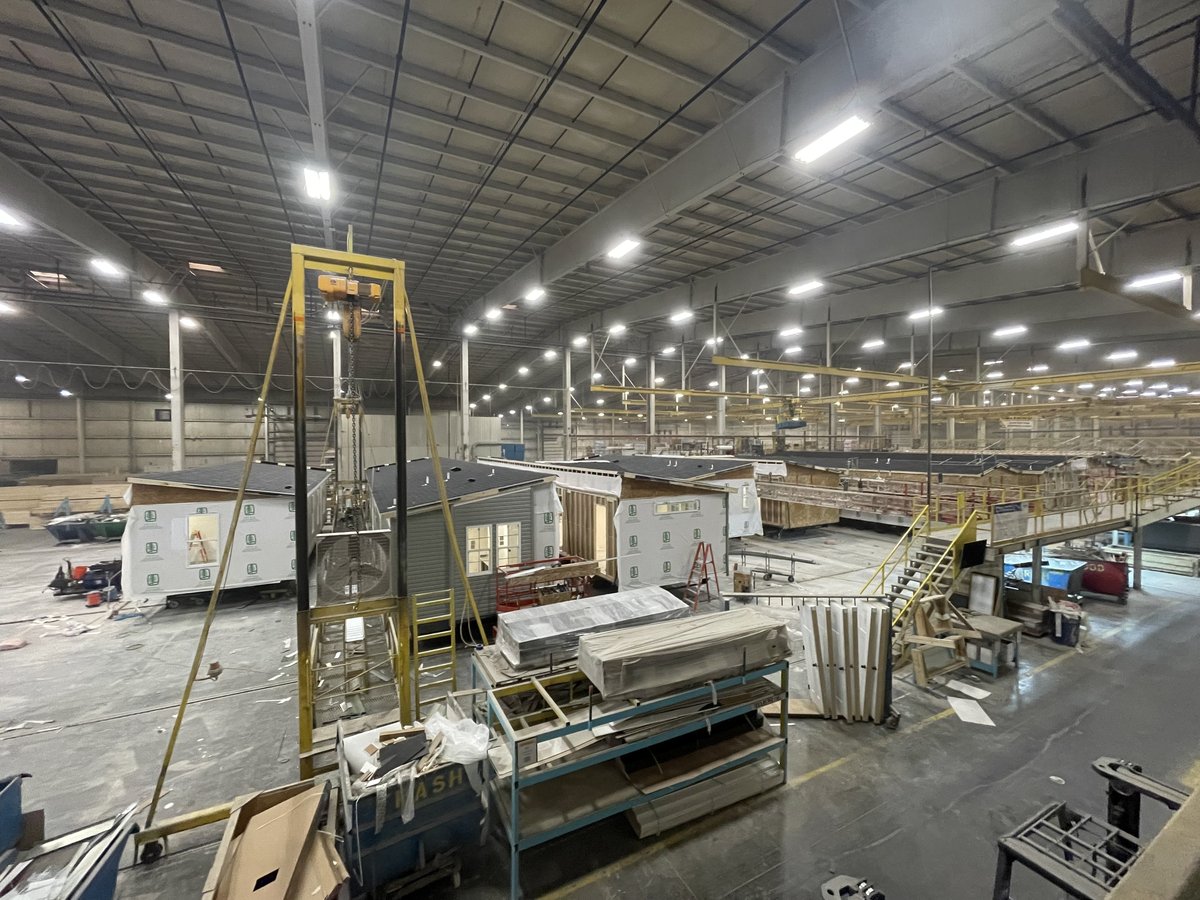
I'm curious, what is the pay like?
You know, we were going to ask them that and we forgot. But we were thinking between the high 20s to probably low 40s [per hour], for the most part. So some are more skilled than others, of course, and some can come in with no skills, and they'll train them, which I would suspect they're probably somewhere in the mid to high 20s per hour for unskilled labor.
Per hour. Great. And does it come with benefits?
Oh yeah, full benefits.
Well, you're going to have a workforce coming with Micron settling in near Syracuse. They predict up to 50,000 jobs, and 10,000 of those are going to go just to the construction of their mega plant there, the chip plant. All the other jobs are going to be related to the people either working there, or other industries that rise around the plant. And they're all going to need a place to live. So are you braced for that? How are you braced for that?
We're ready. We're eager for it, but I don't think anyone's really ready for it. They're definitely struggling. We got a call from some people trying to put together about 1,000 homes up in the Clay area, but they're still working on trying to find land. One of the things that we can do, Ralph, is we can do what's called a man camp, and if we just had some land, we could put single-section homes up very, very quickly, and they would just be temporary housing. If someone said, hey, Jeff, I want 100, 200, 300 houses, and said, you can start tomorrow, we can have people living in a home like that within 6 months of construction. But we know that it wouldn't happen. There's going to be a continued scarcity of homes for the construction workers and the employees, if we don't get some more relief from zoning and regulations and stuff like that.
What's the biggest thing standing in the way? Zoning, neighbors, permits, financing, and how long does approval actually take on a typical lot?
I think the financing thing is pretty figured out. Gov. Hochul signed a bill last year to make manufactured housing part of real property. Anywhere that single-family homes are allowed via the zoning code, you can have a manufactured home. But then again, Ralph, there's the theoretical and there's the practical. Even though that law is on the books, I've had municipal officials tell me — we looked at a piece of property in an unnamed town that was zoned for a manufactured home, for a land-lease community, and they told me point blank, go ahead, try to get it approved. So I think NIMBYism, be it within the government itself and also certainly within neighbors, and then just NIMBYism as far as any type of development. The problem is those officials are elected, and most of them want to get reelected, and if they don't listen to and appease the loudest voices, which are the NIMBYs, they're not going to get reelected.
So what is that stigma that you're facing and how are you, what are you doing personally to overcome it? Are you on a campaign to educate lawmakers, the public? How are you going about that?
One of our key strategies is to try to (promote) the correct information about manufactured housing. Every day, like (how) I'm doing with you, I talk about the virtues of manufactured housing, and how it can be part of the solution to the housing crisis, and we do that in front of lawmakers, elected and appointed. We do it in front of the media, any chance we get — television stations, radio stations, print, obviously social media. We can put a very nice, affordable 3 bedroom, 2-bath (manufactured) home, about 1,200 square feet, in one of our communities, and we'll sell that home for anywhere from, depending on the exact location, anywhere from $70,000 to $80,000. Now, they have to pay a lot rent, which is going to vary by location anywhere from $500 to mid-$600 per month. We love manufactured housing. We think it's a great solution to the lack of housing at many different price points, from $80,000 to well into the 400s.
And what exactly is that stigma you're facing? What do they think? What are the naysayers thinking?
It goes back to the trailer park days. Manufactured homes started as travel trailers. And this is back in the '40s, the '50s post-war. People drove around with their trailers and started congregating in locations, and they started calling them trailer courts, and then eventually mobile home parks, as the residents stayed longer and longer. So a lot of the stigma is that trailer park mentality, kind of like what we see in “8 Mile,” the movie with Eminem, about 20 years ago outside of Detroit. Just trashy homes, broken windows, pit bulls running all around. It can be very working class, 2-star communities with run-of-the-mill homes where people are making $20, $25 bucks an hour, all the way up to beautiful 5-star communities with pools and shuffleboard courts and community centers and homes selling for $350,000. With the younger generations, they don't have that same stigma as people in their 40s and 50s, or older.
A quick follow-up to that. Who's actually buying? First-time buyers who've been priced out? What does within reach mean in dollars for a Rochester family?
We see our biggest customers in our existing land-lease communities, (and they) are certainly first-time home buyers. And seniors to a certain extent, but definitely more first-time home buyers. For so many years, a senior who wanted to downsize (found it) might cost them more money to downsize into a smaller house than it would to stay in their current home, because their interest rates and construction costs, et cetera. But now with manufactured housing, they certainly could get into a smaller home, and they certainly could save some money by doing so.
To wrap this up, is Upstate New York competing for residents and investment with the rest of the country, not just New York City? What does Rochester need from Albany that it's not getting?
Our zoning is local, as we know. And I know Gov. Hochul and the state are working very hard to get more communities to... (become more) pro-housing... which is helpful because that opens up a lot of state funding and state grants for infrastructure improvements, et cetera.
About Ralph R. Ortega
Ralph has been a reporter and editor for several major newspapers and magazines for more than 30 years, and is now vice president of public affairs at O’Donnell & Associates.
Most recently, he was the editor-in-chief of the award-winning City & State NY magazine. At City & State, Ralph managed a team of talented journalists covering the downfall of former New York Gov. Andrew Cuomo, the ascent of current Gov. Kathy Hochul, New York City Mayor Eric Adams’ election campaign and later his administration, as well as the election of Mayor Zohran Mamdani. In his role, Ralph became a well-known player in New York’s political world, emceeing, moderating, and conducting interviews at City & State events. He also wrote a weekly column that focused on policy, transportation, and advocated for greater Latino representation at City Hall and in city government. Read Ralph’s full bio and contact information.