
Citizens Budget Commission goes ‘On the Record’ on AI
The CBC hosted two panels of experts to discuss how the new technology will impact New York state’s government and economy.
By Ralph R. Ortega
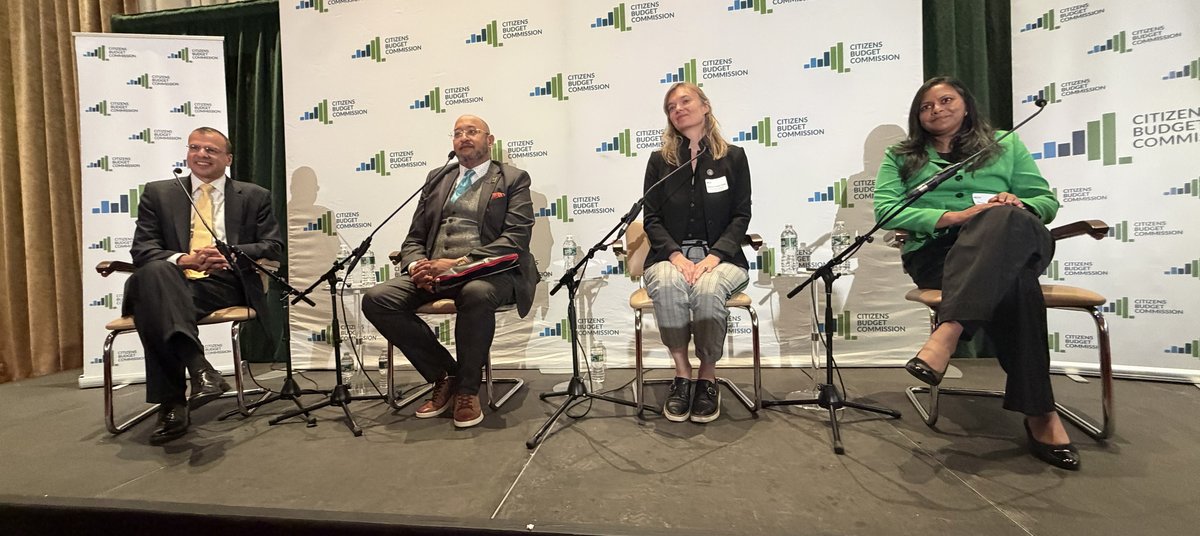
Photo: Ralph R. Ortega
Artificial intelligence right away can be used as a tool for more efficient government services throughout New York state, but not one for replacing workers, panelists told attendees at a Citizen Budget Commission breakfast in New York City.
The event, “How AI will reshape New York’s economy and government,” held in Manhattan featured two panels: The first, "Leveraging AI to improve government," was moderated by Rohit Aggarwala former commissioner, NYC Department of Environmental Protection and chief climate officer, and featured Eleonore Fournier-Tombs, Ph.D., chief AI officer, New York State; Henry A. Garrido executive director, District Council 37; and Hrishika Vuppala, senior partner, McKinsey & Company as panelists.
The second, “AI’s impact on New York’s Economy,” was moderated by Melissa Román Burch executive director, Stephen A. Schwarzman Foundation; former COO, NYC Economic Development Corporation, and featured Kurt Chauviere senior managing director, Blackstone; Virginia Maloney Member, NYC Council, District 4; Robert Seamans, Ph.D. professor, NYU Stern School of Business.
O’Donnell & Associates’ ‘On the Record’ was on hand for the discussions which, explored how government is adapting to AI and examined its impact on both the public and private sectors.
This transcript has been edited for length and clarity.
Panel 1: Leveraging AI to improve government
Rohit Aggarwala: What are the greatest opportunities for AI to improve government?
Hrishika Vuppala: What we're seeing is that, while there's a lot of hype, there's some real impact across the public sector. We recently went through an inspiring exercise where we looked at about 76 such cases from governments across the world. And I'll bring them to life through a couple of examples... So, in one of these agencies that's responsible for mission critical supplies and logistics. They were experiencing increased workloads, but a diminished workforce. And instead of asking for head count, what they decided was to go and address the bottlenecks. They decided to focus on their procurement domain, applied AI to take over the paperwork of putting a first draft RFP together, elevated their workers from being RFP writers to being quality supervisors... On a more local level, the city of Austin addressed its site planning process. That used to be a 1,400 step process across 11 departments touching 250 staff... And then applied AI. So that cycle time now has gone down dramatically. A review takes something like 15 weeks, which is the aspiration of their mayor has said.
Rohit Aggarwala: What opportunities do you see for AI across New York State government?
Eleonore Fournier-Tombs: Yes, so New York state government is really huge... But there's just so much opportunity, I think, to cut down red tape... to make work more efficient for state workers. And the other aspect of that is, of course, to improve the experience of residents when they're interacting with the state. So we've created a Chief AI office. It's relatively young, just over a year old. And our mandate is to deliver responsible AI across the state. So we're not necessarily pushing AI at all costs. We're trying to have a balance and careful approach. ... where we work across 3 pillars. So we have the innovation pillar, which deploys AI, across different agencies. and supports agencies in procuring their own solutions, which might not be general purpose solutions. Then we have the governance pillar, which is responsible for the implementation of the acceptable use policy, and we can talk about it in a little bit more detail, but has elements like human oversight and so on. And we have the education pillar, which is responsible for training and upscaling state workforce in the executive agencies, which is 130,000 people... We don't have, automated decision making in the state when it comes to, residents. So we don't want final decisions to be made by AI Tools, but certainly just streamlining these processes so you don't have to submit four forms that are stored in PDF in a folder.
Rohit Aggarwala: Is IT the right place to start, and how have you seen AI organized elsewhere?
Hrishika Vuppala: What we've seen doesn't work is what I would call a scatter shot approach, right? Like, 5,000 use cases. What we see work is when a state or a municipality or a government takes strategic bets in what I call Goldilocks sized units, called domains, right? It's got to be big enough to really move an outcome... One is that every time you take a domain led approach, you actually involve staff who know that domain really well, and know how to reimagine it, that leads to a 70% probability of success, as opposed to a 30% probability when it's use case and pilot life. The second is that when we look at the value that comes from AI, 60% of it comes because we'll change the work around the process and not just from the technology.
Rohit Aggarwala: What training are you providing, and who is it reaching?
Eleonore Fournier-Tombs: We have a training program in place for all new state workers, working for executive agencies... And so anybody who has access to a generative AI tool as a work tool has a mandatory training that they have by to undergo... And that training is what we were calling a kind of basic literacy training... And so we go through prompting, ethics, and what is AI. So that's the 1st step. Then we have been releasing online trainings that are volunteer and that go into more depth... Then we're doing a lot of leadership, because we found that the leaders are getting a dual pressure. One is to adopt AI as quickly as possible, then one is to reject AI... And so we've been doing a lot of focus on bringing in, you know, expertise from academia, from other states... We've partnered with the unions and we've actually gotten a grant from the unions to do 2 big trainings that are kind of training the trainers.
Rohit Aggarwala: How do you involve long-serving workers in identifying opportunities without them feeling threatened?
Henry A. Garrido: We passed local 35 in 2022 and basically what we said is, we're going to implement this technology across the board... The application however, has been completely opposite... I can apply this to your agency, to your little silo, but you cannot, under any circumstances, use what I apply to you, to any other city agency. So the procurement itself has become difficult... you think about, how long does it take for a permit in the Department of Buildings to go through right now?... But I think as long as you don't integrate that workforce, into the thinking, but rather than continue to use it as an, you know, apply it as an afterthought, you're going to have problems... So, I think, I don't want to be the guy that throws cold water to the enthusiasm of the AI boom in New York City. But I can tell you as long as it continues this way, we would be behind the curve.
Rohit Aggarwala: What are your members telling you about AI, and what are you telling them?
Henry A. Garrido: The concept of just using something that could be efficient … make(s) total logical sense for a machine, (but) doesn't apply when it comes to the human element of making the decisions.
Rohit Aggarwala: How do these concerns affect AI adoption more broadly, and how do you address real problems versus fears?
Hrishika Vuppala: When applied thoughtfully, 3 things will be true. Number one, we will build in breaks into the process. So humans will retain the audit and governance... The 2nd thing is that, Humans will do the tasks that humans are best placed to do, right? Apply practical judgment, and machines should take over the tasks that are more routine and more rules-based, right? And the 3rd is that jobs will change, right? If this is done well, you are no longer going to be a bureaucrat checking paperwork, but you are going to be a supervisor of autonomous agents... successful organizations, especially in the private sector, almost budget for $5 of change for every $1 in tech … to really drive that difference in mission ROI.
Rohit Aggarwala: How would you design a faster building permit process with AI, starting from the people doing the work?
Henry A. Garrido: I would start, rather than with a technology art, start with the people who are actually doing the permits to begin with... this is less about replacing a project manager or an architect department of building who's processing a bill, a form... What I am, thinking about is the moment that AI skip the steps and the building collapses, the public loses complete trust in government, not in the AI agent, right?... And I think if you think about forms that you repeat consistently, that my members will have to replicate, makes no sense... So, I would say start with a human, with people actually doing the work, rather than with the technology and what it's capable of doing... So if you tell the average New Yorker, it [will] reduce the building permits from 19 months to 3 months? But it's going to cost you another $200,000 for permit because I got to buy an agent.
Rohit Aggarwala: How do you help workers who built careers on filling out forms move into quality-control roles?
Hrishika Vuppala: We're enabling civil servants to operate at top of the license, right? So they're doing things that I would believe they have wanted to do and have not been able to do, right? And so, step No. 1 is really showing them and actually letting them define what that could be... In a process where some of the red tape is taken out, actually allows the caseworker to engage at a social, emotional level with a person at their most vulnerable point ... That's what the freedom time has to enable them to do... We've actually seen this in DMVs ... when they were able to … streamline, figure out, hey, how do I take this 25 step process down to 2 steps, like use technology to validate forms... What we saw was that staff actually now engaged with the people applying for a license, right? It felt more human.
Rohit Aggarwala: How do you convey that shift to human value-added skills, and how does governance support it?
Eleonore Fournier-Tombs: I think governance is really the foundation. We're not able to deploy AI tools, especially at scale, if we don't have a solid foundation of governance. And so our policy... covers fairness and equity... It covers human oversight. It covers transparency, also communicating to New Yorkers that AI tools are being deployed... We've been working since February to put together a handbook and a kind of methodology for actually making sure that you have human oversight. Because making sure you have human oversight doesn't mean, okay, so when the AI tool is doing your casework and putting a decision, you just look at it... It's a lot more detailed and nuanced in terms of how to actually make sure that there's a human in the loop in a meaningful way and they can make decisions.
Rohit Aggarwala: How many of your members want to become managers of an AI tool versus staying in their current jobs?
Henry A. Garrido: We recently sent a survey to our members and found that only 40% of those that responded... felt that AI was going to significantly change our jobs... I think I reject this view of the union as being protectionist, of a status quo... I think the problem we have is city workers are not seeing themselves as part of an integrated process for using the tool or rather seeing themselves as a consequence of it, right? And so, I don't want to be a manager to an AI tool that I know has implicit eyes, and I know it's going to be counter to my mission.
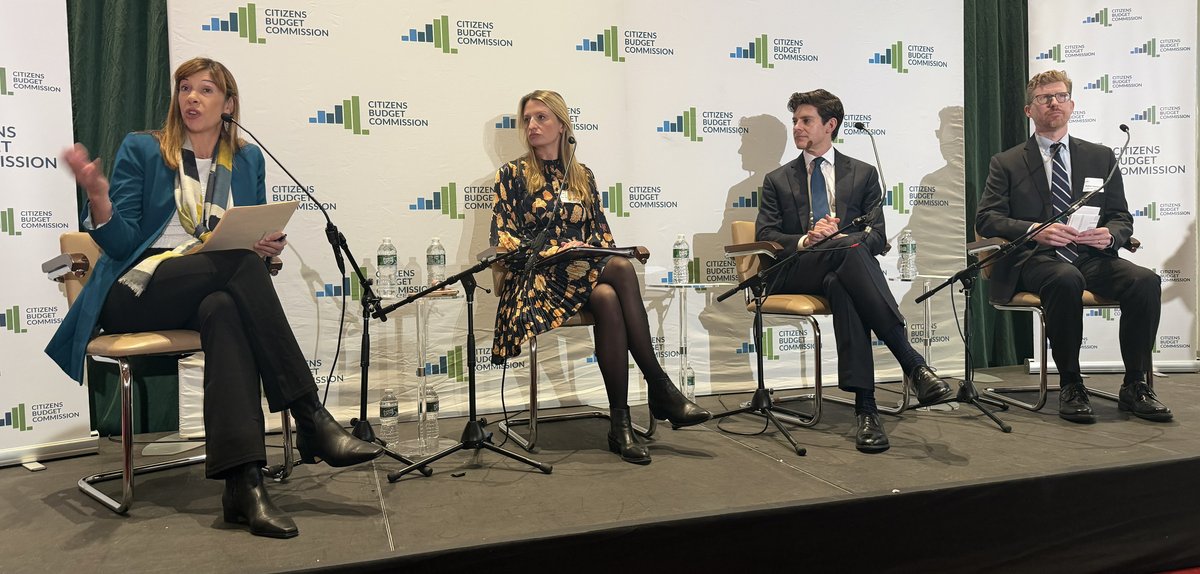
Photo: Ralph R. Ortega
Panel 2: AI's impact on New York's economy
Melissa Román Burch: How will AI reshape the New York economy and its jobs over time?
Robert Seamans: AI is a general purpose technology... They all lead to economic growth. They all lead to new jobs and better jobs... The way that I like to think about this is I think about jobs in three different buckets: Bucket 1 is the bucket that cuts all the headlines, that sort of jobs that disappear, job losses. I actually think it's the smallest bucket, but nevertheless, the one that gets the most attention. The second bucket are new jobs, and in particular, sort of new to the world jobs that get created... The third bucket, I think, is the biggest bucket of all... That's all of our current jobs, and the ways in which those jobs are going tbe changing...
Melissa Román Burch: How far has AI adoption gone in New York's major industries?
Robert Seamans: Most organizations have not adopted AI in any meaningful way... So, finance industry, 41% of firms nationwide have adopted AI... it takes a long time, and a lot of investment... purchasing the technology is the easy part, but … the change that is required takes time.
Melissa Román Burch: How is AI actually changing work inside Blackstone and its portfolio companies?
Kurt Chauviere: Blackstone, we're on the record saying we've seen a 9x increase in our token consumption in the first half of the year internally. Our portfolio has about a 29 fold increase, and there's spend on AI, comparing last year to this year... We work with one of our portfolio companies... and we built this engine that allows us to go and review... about 30,000 documents a year. And that's been pretty powerful. We actually were able to remove a lot of consulting hours, lawyer hours, from how that work was done... We've launched an investment committee review product for all of our investment committees across all of our strategies...
Melissa Román Burch: What does a 29-fold increase in AI usage actually mean?
Kurt Chauviere: The 29 fold increase comes from the fact... not every company has adopted, not every company has switched it on... We're seeing more companies switch it on. So you're starting from a low foundation, but as you go into 2026, that low foundation has more and more companies that are in it. And then those that get serious about it actually see a pretty dramatic increase in consumption.
Melissa Román Burch: What should government do as AI becomes part of everyday life?
Virginia Maloney: I certainly think government has a clear role to play here. The first area I'd think about, since we're talking about economic shifts, is promoting economic development here in New York. We want to make sure that AI companies are founded here and that the next frontier of jobs are in New York City... where government can play a role is investing in AI literacy and workforce development. Our investment right now, I think we need to do a lot more in making sure that our workers are prepared for this shift. Groups like Pursuit are starting to do this with public private partnerships, helping to train the next generation, next group of workers, for these types of roles. The other big bucket is AI safety... We've heard how state officials are stepping in with the Rays Act, and at the city level, we had a hearing with 5 of the frontier models... to ensure that AI is used safely. And then I think another area is access. We want to ensure that all businesses, including small businesses, are a part of this wave of learning about the new technologies, and that women and people of color are also getting exposure.
Melissa Román Burch: Which AI issues belong at the city, state, or federal level?
Virginia Maloney: At the city level... I think there are so many opportunities and low hanging fruit for government to adjust our procurement methods and use this technology to help civic employees do more. I think a key point here is that we're not talking about job replacement... It's a tool to accomplish more. On the city level, I think a lot about city preparedness, too. You know, how are we preparing our city infrastructure, our electric grid, our water systems, for AI?... I think a lot about the Department of Education, and how are we introducing AI literacy at an age appropriate level, and graduating our high schoolers with the skills that they need to be successful in the workforce. And similarly, the CUNY system... Obviously, any safety regulations you'd rather see at a statewide or federal level, so that companies aren't dealing with a patchwork of legislation.
Melissa Román Burch: What skills should training and education focus on?
Robert Seamans: Focusing on training and reskilling is really important... I think it would be a mistake to sort of try to target some very specific type of skills. Instead, I think training and retraining programs should be developed in a way that they are adaptable, and can sort of meet the worker where they are, and can build off of whatever skills they have. And then train them as best as possible in skills that firms are forecasting. They're going to need sort 12 to 24 months in the future.
Melissa Román Burch: Which skills are being replaced, and which are becoming more essential?
Kurt Chauviere: If we look in the legal industry, the sort of first year hiring is down for the first time since the financial crisis... I just declined to hire an associate on my direct team, because I have Claude and Cowork and Harvey. So that's actually what that person would have been doing for me in years prior... The entry level jobs, we just don't need them to the same degree that we did, or we don't need external support in those areas...
Melissa Román Burch: What is the outlook for new college graduates entering New York's workforce?
Kurt Chauviere: That market, that entry level market, has seeing a real pullback in the last year or two in terms of people being able to get the entry level seats, at tech firms, banks, and other financial institutions... If you look in the world of coding, you probably saw the news yesterday that Microsoft offered a buyout to 60,000 of its employees... part of what's happening here is you can be much more productive at software production, maintenance... The trick is just to increase your productivity with the tool and become the worker that is going to be participating in the economy in the way that it's going to work in the future.
Melissa Román Burch: What attitude shift should government encourage around AI skills?
Virginia Maloney: When we talk about AI skills, really, what we're talking about is AI literacy or AI fluency... I think if we look at back to the access and adoption, the curve is, there's certain sectors of the economy or society that are adopting AI and use it regularly, and plenty of people were being left behind. So it's also an attitude shift that government needs to help encourage. Because I think, the way I think of it is that jobs will not be taken by AI. Jobs will be taken by humans who are AI literate, and are able to be more productive.
Melissa Román Burch: How is the city thinking about AI access for small and medium-sized businesses?
Virginia Maloney: It's a perfect segue to an event I'm hosting tomorrow. which is for district 4 businesses, for any, any business interested in learning more about AI literacy. We’re partnering with the Manhattan Chamber of Commerce, and Welcome to Chinatown for a two hour training. Bring your laptop... The group will help the small business owner create an agent that is able to accomplish that same task... So I think programs like that, where you're showing small businesses, how they can utilize these tools to accomplish their daily tasks cheaper and more efficiently... Another group, I think, of about is women, who are historically, the minority in tech companies... So, as the economy evolves, women have fought so hard to earn a seat at the table, but the next wave, we need to make sure we're there at the front lines.
Melissa Román Burch: How should higher education change to build the talent pipeline?
Robert Seamans: When I'm not doing research, I'm teaching... I think there's two things here. First, there's a lot of excitement around the ways in which the tools can change the way in which we deliver content or the way in which we engage students... I think where people worry a lot is on the evaluation side, right? So the way that we give tests and exams, and sort of evaluate in general, will have to change... It really can no longer be the case that someone comes into a university, they sort of are subjected to me for four years. And then they go out and find a job... And so what we are increasingly seeing, and what universities are increasingly doing, is a lot of experiential work, where we try to bring in, like, real world problems from Blackstone or Latham, or wherever, into the classroom, and get students to work and get experience.
Melissa Román Burch: How can judgment be developed earlier as entry-level work shrinks?
Kurt Chauviere: One thing that struck me was the more senior I got, the more I became a psychologist and a personal counselor, and not actually a business advisor. I don't think that's going to change... I think, you know, to that extent, there will be a judgment layer that always survives... When we look at our work today, I think the good news is we're still on a point where the judgment is not being substituted. You are getting increasingly supported in more and more ways... when it comes to our compliance systems, so the very core things that we need 100% accuracy around... there is a very strong human labor review. The models are very helpful. They provide suggestions, they provide citations, but engineered into the entire architecture is a rigorous human review, because ultimately, that would be the person that has to represent it before the SEC or some other body.
Melissa Román Burch: Is New York more at risk from AI, or stronger because of its talent and scale?
Virginia Maloney: Well, like most representatives of New York City, I think New York City's the best city in the world. But our talent workforce means that, too. So I think, regardless of what the future holds, young people companies will be here because young people want to be here... I'd say the other thing you think about a lot in the New York City Council, you can't really have a conversation about economic development, without talking about affordability, and the cost of living in New York. So that's one of the biggest drivers of companies moving out of New York City is just the cost of operating and the cost of maintaining a large workforce here... For the tech sector, I used to work in economic development for Mayor Bloomberg, at NYCEDC, in 2012, when you were trying to compete with Silicon Valley with Silicon Alley... And I think we're in a moment where city government and ADC needs to look at the AI sector, and where are AI applied AI companies developing, and what can we do across each of those sectors to make sure those companies are coming to New York. Those founders are coming to New York, rather than Silicon Valley. But I'm optimistic, because New York's the best city in the world.
Melissa Román Burch: What is the single most important thing New York must do in the next year?
Robert Seamans: I would come to some of the topics that the 1st panel discussed around government efficiency … to the extent that we can improve government. I'm shocked to hear that (it takes) 18 months to get a building permit. I mean, come on. If we could cut that in half, think about the amount of economic growth we could get in the city.
Virginia Maloney: Government efficiency … I think there's a lot of low hanging fruit in government efficiency, and affordability is top of the agenda. I think the other more meta theme would be not to be afraid... The answer is to, in my opinion, is not to pretend this isn't happening, but embrace it, and figure out how you can responsibly adopt the technology.
About Ralph R. Ortega
Ralph has been a reporter and editor for several major newspapers and magazines for more than 30 years, and is now vice president of public affairs at O’Donnell & Associates.
Most recently, he was the editor-in-chief of the award-winning City & State NY magazine. At City & State, Ralph managed a team of talented journalists covering the downfall of former New York Gov. Andrew Cuomo, the ascent of current Gov. Kathy Hochul, New York City Mayor Eric Adams’ election campaign and later his administration, as well as the election of Mayor Zohran Mamdani. In his role, Ralph became a well-known player in New York’s political world, emceeing, moderating, and conducting interviews at City & State events. He also wrote a weekly column that focused on policy, transportation, and advocated for greater Latino representation at City Hall and in city government. Read Ralph’s full bio and contact information.